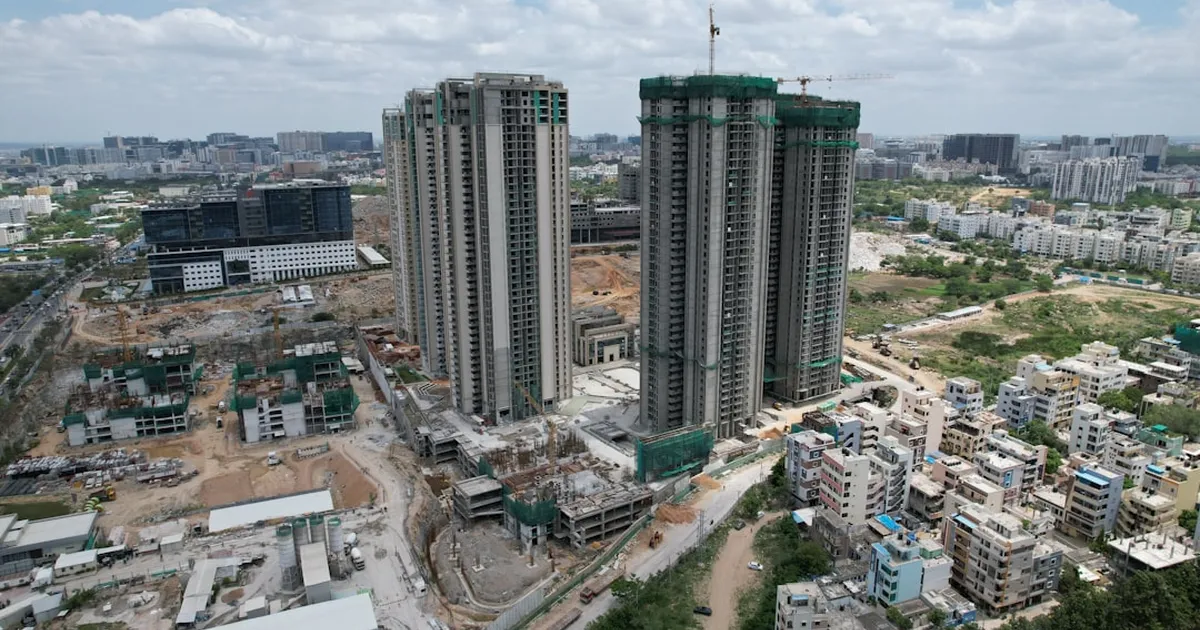
Hyderabad Real Estate New Home Launches Crash 46 Percent In Q1 2026 As Oversupply And Affordability Concerns Trigger Sharp Market Slowdown

Hyderabad New Home Launches Plunge 46% in Q1 2026 as Developers Halt Supply Amid Inventory Glut
Hyderabad's residential real estate market delivered a shock in the first quarter of 2026: new home launches crashed 46 percent year-on-year to just 9,700 units in Q1 2026, down from 17,874 units in Q1 2025. Most striking was March 2026, which recorded zero launches—a complete standstill. This represents the sharpest single-quarter decline across all major Indian metros, signaling a dramatic shift in developer strategy as oversupply concerns and affordability pressures reshape the city's housing landscape.
The data comes from the Q1 2026 India Residential Real Estate report by market research firms, covering six major metros that collectively launched 104,882 units across 633 projects. While national supply remained broadly stable, Hyderabad's divergence was stark. Just three projects accounted for 75 percent of the city's entire Q1 supply, with the 52.87-acre My Home Udyan mega-township in Tellapur contributing 3,343 units alone. This concentration reveals a market where developers have largely withdrawn from launching new projects, preferring to focus on completing and selling existing inventory.
The Paradox: Prices Rise While Supply Crashes
What makes this story counterintuitive is that Hyderabad's residential market has not collapsed. Property prices actually rose 9 percent year-on-year in Q1 2026 to reach a weighted average of Rs 8,211 per square foot—among the strongest price appreciation in India. Sales volumes held steady at 9,541 units, up 1 percent compared to Q1 2025, making Hyderabad one of only two southern metros (along with Bengaluru) moving against the national slowdown, where sales fell 4 percent nationally.
This apparent contradiction tells a specific story: developer supply has not crashed because demand has weakened, but because inventory levels have become unsustainable. With over 97,000 unsold units sitting in the market, developers have simply stopped launching new projects. Instead, they are focused on clearing existing stock. The market is not collapsing—it is being rationed.
Impact on Homebuyers: A Tale of Two Markets
The real impact is deeply segmented by price point. Buyers in the premium segment (Rs 1 crore and above) are thriving. The Rs 1 crore to Rs 2 crore bracket dominated Q1 2026 sales with 4,061 units, while properties above Rs 2 crore also recorded strong momentum. This premiumization reflects Hyderabad's booming IT employment sector, which added 5.86 million square feet of office space in Q1 2026—a historic quarterly record and 48 percent jump year-on-year. High-earning tech professionals are buying quality homes without price sensitivity.
For middle-class and affordable-segment buyers, the situation is dire. Developers have largely stopped building homes under Rs 1 crore, shifting their focus entirely upstream. The affordable housing segment below Rs 50 lakh has shrunk dramatically. Market research indicates that 84 percent of buyers seeking homes under Rs 1 crore are facing extreme stress due to a supply-demand mismatch. In western zones like Kokapet, Gachibowli, Narsingi, and the Financial District, 80 percent of available apartments are 3BHK or larger units priced above Rs 1.6 crore.
For buyers still in the market, this creates mixed signals. Premium buyers should act soon—inventory is tightening in their segment. Middle-income buyers face a waiting game: either prices must moderate (unlikely in the near term given strong IT employment) or developers must shift focus back to affordable units (unlikely unless demand picks up). The safest strategy is to focus on ready-to-occupy homes with clear approvals inside the Outer Ring Road, where absorption has been strongest.
Expert Analysis: Why Developers Slammed the Brakes
The 46 percent launch decline is not a sign of market weakness—it is a rational developer response to oversupply. Hyderabad's unsold inventory of 97,000+ units would take roughly two years to clear at current absorption rates. Adding new supply in this environment would only deepen the problem. Developers are choosing to preserve margins by completing existing projects and managing inventory rather than launching into a buyers' market.
The affordability crisis is the second driver. Rising land costs, construction inflation, and buyer preference for larger, premium units have pushed developers away from sub-Rs 1 crore projects. These projects carry thin margins and take longer to sell in a market where qualified buyers increasingly have higher purchasing power. Why build 100 small units when you can build 30 large units and earn the same revenue with less execution risk?
Hyderabad's commercial real estate boom is the underlying engine. The city's office sector added 3.15 million square feet of gross leasing in Q1 2026, with multinational corporations and IT companies expanding aggressively. This employment growth is real and sustainable, supporting the 9 percent price appreciation. However, this growth benefits only the upper-income bracket. The city's wage distribution has not shifted—most of the 9 million residents still earn Rs 5-15 lakh annually, making homes at Rs 1.6 crore+ completely unaffordable.
What to Expect Next: A Two-Speed Market Ahead
Developers will likely keep new launches muted through Q2 and Q3 2026, focusing instead on clearing inventory. Expect continued price firmness in the premium segment (Rs 1-2 crore and above) but growing pressure on mid-range and affordable units as inventory builds. If interest rates moderate (the RBI has already cut rates by 125 bps during 2025), some relief may come to affordability-stressed buyers, but this is not guaranteed.
The real estate market will likely split further: premium and ultra-luxury segments will remain supply-constrained and price-appreciating; mid-premium and affordable segments will see developer discounting, extended payment plans, and possible price moderation by late 2026 or early 2027. Buyers in the Rs 50 lakh to Rs 1 crore range should expect to negotiate harder and wait longer.
Key Takeaways for Buyers
- Premium buyers (Rs 1-2 crore+): Act now. Supply is tightening, prices are rising, and absorption is strong. Delay may cost you 5-10 percent more.
- Mid-range buyers (Rs 50 lakh to Rs 1 crore): Wait and negotiate. Developers have inventory pressure and will offer incentives. New launches will remain rare, but resale options and negotiated ready-to-occupy homes will improve.
- Affordable-segment buyers (below Rs 50 lakh): Expect limited options. Consider areas outside the Financial District or look for government-backed schemes like Indiramma Housing or PMAY-U 2.0.
- All buyers: Focus on ready-to-occupy homes with clear HMDA/DTCP approvals inside the Outer Ring Road. These are absorbing fastest and carry the lowest execution risk.
Comparable Markets & Context
Hyderabad's 46 percent launch decline is the steepest among India's six major metros. Mumbai's new launches fell 7 percent, Delhi-NCR dropped 11 percent, and Pune fell 11 percent. Bengaluru and Chennai showed resilience, but neither saw Hyderabad's dramatic pullback. This makes Hyderabad unique: strong sales and rising prices, but developer supply has effectively halted. The city is in a supply-constrained phase—not demand-constrained.
The Bottom Line
Hyderabad's real estate market in Q1 2026 is not in crisis—it is in transition. The 46 percent launch crash reflects developer discipline, not buyer panic. Prices are rising, sales are steady, and employment is booming. However, this growth is concentrated at the top end of the market. Middle-class and affordable-segment buyers are being priced out, and developer supply has stopped serving them entirely. For the next 12-18 months, expect a bifurcated market: premium segments remain hot, mid-range segments cool with negotiating power, and affordable housing remains critically undersupplied. Buyers must choose their segment carefully and manage expectations accordingly.
Questions & Answers (0)
Terms & Conditions — Q&A
By submitting a question on RealtyPromoo, you agree to these terms:
1. Content Policy
- Your question must be a genuine real estate query.
- No abusive, defamatory, or promotional content.
- No personal contact info, broker referrals, or spam.
- Questions are reviewed by AI and may be edited for clarity, grammar, or politeness before publication.
2. Publication
- Your first name + last initial (e.g., "Rahul S.") will be displayed publicly with the answer.
- Your full name, phone number, and email are never displayed publicly.
- Once published, your question and answer become part of RealtyPromoo's content.
3. Phone & Email
- Your phone number is required so our team can share the answer with you on WhatsApp and assist with your query.
- Your phone number and email are stored securely and may be used by RealtyPromoo or its sales team to contact you regarding your query or related properties.
4. Answer Accuracy
- Answers are generated by AI based on publicly available information and the page context.
- Answers are informational only — not financial, legal, or investment advice.
- Always verify pricing, RERA status, and possession dates with the developer before any transaction.
- RealtyPromoo is not liable for decisions made based on AI-generated answers.
5. Pre-RERA / Pre-Launch Projects
- Some listed projects are pre-RERA / pre-launch. These listings are informational only.
- No booking, sale, or agreement is permitted before RERA registration.
- "Express Your Interest" forms collect contact details for future communication, not advance bookings.
6. Moderation
- RealtyPromoo reserves the right to delete, edit, or refuse to publish any question or answer.
7. Privacy
- Your data is handled per our Privacy Policy.
8. Jurisdiction
- These terms are governed by the laws of India.
- Disputes are subject to the courts of Noida, Uttar Pradesh.
Be the first to ask a question. Get an answer in seconds.
Questions & Answers
This article was drafted by Aditya Verma, Senior Property Analyst (Freelancer) with research support from artificial intelligence. AI assisted in gathering and summarizing information from primary news sources and official statements, and the final content was reviewed by our editor before publishing. News pages are timestamped at the time of writing and are not updated after publication.
Sources consulted: Primary press releases & company statements · Tier-1 business news (Economic Times, Livemint, Moneycontrol, Business Standard) · BSE / NSE corporate disclosures · Government notifications · State RERA filings (where relevant).
Published: 19 May 2026 · Spot an error? Let us know
Projects mentioned in this article
 Under Construction
Raheja Amaltis
by K Raheja Corp Homes (k Raheja Corp Real Estate Private Limited)
Sion West, Central Mumbai, Mumbai
₹6.03 Cr – ₹11 Cr
3 BHK, 3.5 BHK, 4 BHK
 Under Construction
Century Liva
by Century Real Estate Holdings Pvt. Ltd.
Yelahanka, Bangalore
₹1.59 Cr – ₹6.30 Cr
3 BHK, 4 BHK, Penthouse
 Pre-Launch
Century Midtown
by Century Real Estate Holdings Pvt. Ltd.
Devanahalli, Bangalore
₹82 Lakhs – ₹1.93 Cr (Apartments) | ₹98 Lakhs onwards (Plots)
1 BHK, 2 BHK, 3 BHK Apartments + Residential Plots
 New Launch
Shapoorji Pallonji The Dualis
by Shapoorji Pallonji Real Estate (joyville Shapoorji Housing Pvt. Ltd.)
Sector 46, Gurugram
₹6.84 Cr - ₹9.50 Cr
3 BHK + Servant, 4 BHK + Servant
Related News
 News
News
Netflix Leases 41,000 Sq Ft At CapitaLand ITPH Hitec City Hyderabad Marking First Major Base In City And Signalling New Wave Of Tech-Driven Real Estate Demand
Netflix signs a major lease for its first office in Hyderabad at CapitaLand's ITPH, Hitec City. Analysis of the impact on residential real estate in Madhapur.
 News
News
Telangana Cabinet Approves Merger Of 27 Municipalities Into GHMC Tripling City Area And Unlocking New Real Estate Development Zones Around Hyderabad
Telangana Cabinet approves historic GHMC expansion merging 27 municipalities. Hyderabad's area triples to 2000 sq km. Real estate impact, timeline, and buyer...
 News
News
Hyderabad Regional Ring Road Southern Stretch Development Begins Boosting Real Estate In Rajendra Nagar Budvel And Outer Hyderabad Corridors
Hyderabad Regional Ring Road southern stretch enters construction phase. Rajendra Nagar and Budvel positioned for 25-40% appreciation as RRR connectivity...
 News
News
Hyderabad Outer Ring Road Phase 2 Expansion And Pharma City Connectivity Boost Real Estate Demand In Rajendra Nagar, Budvel And Kokapet Corridors In 2026
Hyderabad ORR expansion and Pharma City metro connectivity unlock growth in Rajendra Nagar and Kokapet. Current pricing, risks, and buyer strategy for 2026...